Jin Roh: A Masterpiece in Anime Cinematic Storytelling
Jin Roh: The Wolf Brigade is a groundbreaking anime film that stands apart due to its philosophical depth, emotional complexity, and psychological themes. Directed by Hiroyuki Okiura and written by Mamoru Oshii, the 1999 film is based on the Kerberos Panzer Cop manga and remains a cult classic. It takes place in an alternate reality where Japan did not lose World War II and showcases a militarized dystopian society. The narrative follows Kazuki Fuse, a conflicted soldier, grappling with duty, morality, and the cost of violence.
Jin Roh offers more than just action-packed sequences; it offers a poignant exploration of identity, loyalty, and the psychological scars of war. For audiences seeking both intellectual and visual stimulation, this film is a brilliant fusion of animation, philosophy, and political commentary. This piece will explore the intricate themes, characters, setting, and the impact Jin Roh has had on both anime culture and broader cinema.
What is Jin Roh?
Jin Roh, or Jin-Roh: The Wolf Brigade, is an anime film based on the manga series Kerberos Panzer Cop. Set in a dystopian, alternate-history Japan, it imagines a world where the Axis powers won WWII, and the country has fallen under authoritarian rule. The film’s protagonist, Kazuki Fuse, is a member of the Kerberos unit, an elite police force tasked with suppressing rebellion and maintaining order in a politically fractured society.
The story is propelled by a tragic encounter: Fuse hesitates to shoot a young female terrorist, who then detonates a bomb. This event spirals him into an emotional crisis as he confronts his role in a system he finds increasingly difficult to support. The film deftly combines psychological tension with political intrigue, creating a narrative that is both thought-provoking and gripping.
Setting: An Alternate Japan in Crisis
The alternate reality of Jin Roh plays a critical role in setting the tone of the film. Unlike the history we know, Japan never surrendered in WWII, resulting in a world where the country is controlled by a militaristic government with echoes of Nazi Germany’s ideology. In this dystopian society, freedom is a commodity, and state control extends to every facet of life, from law enforcement to the media.
The film’s environment is filled with tension and distrust, as factions vie for power, and the people are caught between oppressive authority and the rebel forces. This dark and controlled world provides a powerful backdrop to Fuse’s internal conflict, emphasizing the societal impact of a totalitarian regime and the psychological toll on those living within it.
The Symbolism of the Wolf in Jin Roh
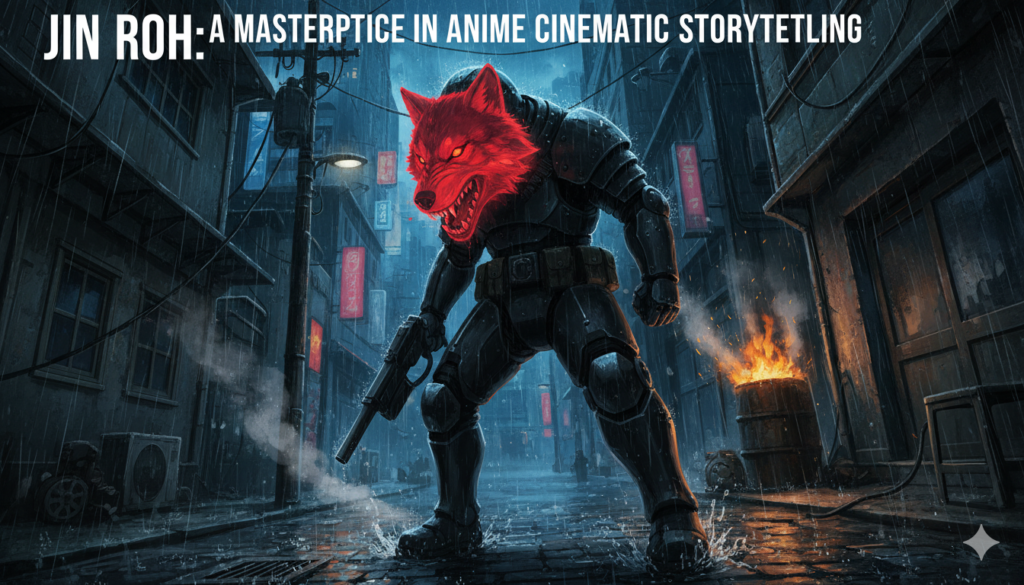
A central metaphor in Jin Roh is the symbol of the wolf, which appears both literally and figuratively throughout the film. The Kerberos unit, which Fuse is a part of, is named after the mythological three-headed dog, symbolizing the military’s role as the enforcer of order. However, in the context of the film, the wolf is more complex, representing not only violence and brutality but also inner conflict.
The Little Red Riding Hood story, a recurring motif, is turned on its head. Here, the wolf does not simply represent danger; it embodies the emotional and moral decay of the protagonist and his society. As Fuse grapples with his role, he becomes the “wolf” haunted by his duty to obey orders, yet questioning the morality of his actions. This symbolism speaks to the themes of identity, violence, and the cost of loyalty.
Character Development: Kazuki Fuse and His Inner Struggle
The central figure in Jin Roh is Kazuki Fuse, an emotionally complex character torn between his duty as a Kerberos officer and his growing awareness of the moral corruption around him. After his involvement in the death of a young girl during an operation, Fuse begins to question his role within the authoritarian system. His interactions with Kei Amemiya, the sister of the girl he killed, force him to confront his emotional and psychological trauma.
Fuse’s journey is one of personal redemption and self-awareness. His emotional turmoil is symbolic of the inner struggle many individuals face when caught between personal morality and state-imposed duty. The film’s exploration of psychological depth is what makes Fuse’s character so compelling and his moral dilemmas so intense.
Kei Amemiya: The Symbol of Innocence Lost
Kei Amemiya, the sister of the young terrorist, plays a pivotal role in the film. Though she is initially perceived as an innocent bystander, her character unfolds as a symbol of innocence lost. Her connection to Fuse creates a tragic, almost romantic tension, as they both struggle to make sense of their lives in a world filled with violence and betrayal.
Kei represents the human cost of the conflict that unfolds throughout the film. While Fuse is forced to confront his role in the militarized regime, Kei symbolizes those caught in the crossfire of larger political struggles. Her tragedy underscores the emotional weight of the film, making her relationship with Fuse one of sad inevitability.
Political Themes: Totalitarianism and Repression
Jin Roh is deeply concerned with the political themes of totalitarianism and state control. The government’s oppressive policies stifle freedom, and the Kerberos unit represents the militarized arm of that control. The secrecy of the state’s dealings and the surveillance of the population create a world where personal freedom is a distant dream.
The film critiques authoritarianism, showing the psychological toll it takes on both the oppressed and the enforcers. The conflict between the Kerberos unit and the rebel forces reflects the broader struggles between oppression and resistance, with the film ultimately asking whether individuals can maintain their humanity in such a system.
Jin Roh’s Artistic Style: Animation and Visual Storytelling
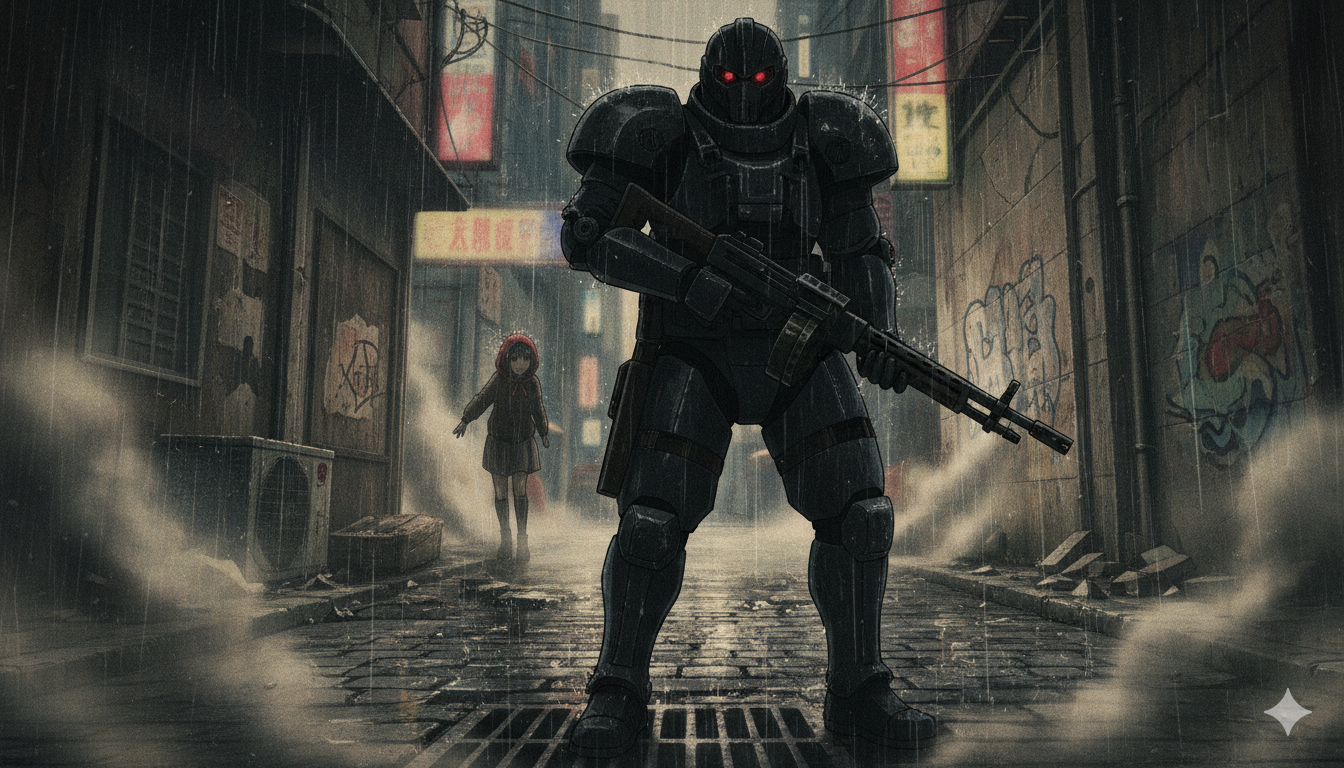
The artistic style of Jin Roh is one of its most striking features. The animation is meticulously detailed, capturing the gritty atmosphere of a dystopian society. The use of dark, muted colors reinforces the oppressive tone, while the fluid animation and action sequences provide moments of intense emotion and tension.
The visual storytelling is equally important in conveying the film’s themes. The landscape, from urban decay to dark alleyways, is used not just as a backdrop but as a symbol of the moral decay of society. The expressionist art style creates an immersive world that enhances the emotional gravity of the narrative.
Philosophical Themes: Humanity, Violence, and Identity
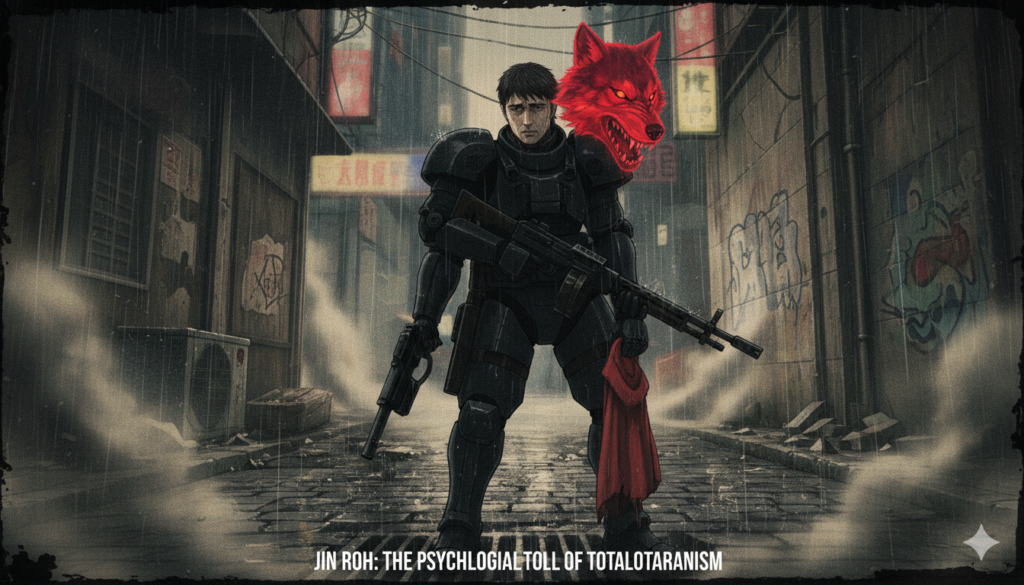
Jin Roh is not just a story about action and conflict; it’s a philosophical exploration of humanity and the cost of violence. The film questions whether individuals can retain their humanity when subjected to a system built on fear, control, and obedience. Through Fuse’s internal battle, the film explores themes of identity, moral responsibility, and the psychological effects of violence.
The portrayal of violence in the film is both literal and metaphorical, as characters struggle with their capacity for brutality while trying to reconcile their personal beliefs. Ultimately, Jin Roh asks the viewer to reflect on their own relationship with violence and societal systems that enforce it.
Critical Reception: Jin Roh’s Impact on Anime and Cinema
Upon its release, Jin Roh was met with widespread acclaim for its innovative animation, deep storytelling, and emotional complexity. Critics hailed the film as a landmark in anime, noting its departure from traditional action-oriented anime in favor of psychological depth and sophistication. The film’s dark tone and mature themes also garnered attention from film critics outside the anime genre.
The film’s ability to blend action, political commentary, and psychological exploration has cemented its place as one of the most influential anime films of all time. Its impact can be seen in its continued cultural relevance and the influence it has had on subsequent anime films that aim for a more mature, thought-provoking approach.
Legacy and Influence: Jin Roh’s Cultural Significance
The legacy of Jin Roh extends far beyond its initial release. It has inspired countless filmmakers and creators to approach anime and animation as a serious medium for tackling complex themes. The film’s exploration of totalitarianism, personal sacrifice, and moral conflict has made it a timeless classic.
Jin Roh’s influence can be seen in works such as Ghost in the Shell, Psycho-Pass, and The Witcher, where themes of psychological depth and philosophical inquiry are central. Its contribution to both anime culture and cinema at large remains undeniable, and it continues to be studied and admired for its artistic and narrative brilliance.
Conclusion
Jin Roh The Wolf Brigade is a cinematic masterpiece that explores the human condition through the lens of violence, duty, and personal identity. Set in an alternate history where Japan is under a militaristic regime, the film examines the psychological toll of totalitarianism and the cost of violence. Through Kazuki Fuse’s internal conflict, Jin Roh becomes a powerful commentary on morality, obedience, and the loss of innocence.
Its innovative animation, deep narrative, and philosophical themes have cemented its place as one of the most influential anime films in cinema. For those seeking a thought-provoking, emotionally rich experience, Jin Roh offers a deeply compelling journey into the darkness of the human psyche.
FAQs
Jin Roh: The Wolf Brigade is a Japanese anime film set in a dystopian alternate history. It follows Kazuki Fuse, a police officer in a militarized Japan, who faces emotional and moral dilemmas after a terrorist incident. The film explores violence, duty, and personal identity in a totalitarian society.
Jin Roh explores totalitarianism, personal identity, and the moral consequences of violence. It critiques the impact of authoritarian regimes on individual freedoms and delves into psychological conflicts surrounding duty versus morality. The symbolism of the wolf reflects brutality and inner turmoil.
Jin Roh explores totalitarianism, personal identity, and the moral consequences of violence. It critiques the impact of authoritarian regimes on individual freedoms and delves into psychological conflicts surrounding duty versus morality. The symbolism of the wolf reflects brutality and inner turmoil.
Jin Roh stands out due to its mature themes, psychological depth, and dark storytelling. Unlike typical action anime, it focuses on moral ambiguity, societal control, and emotional conflict. The realistic animation style and philosophical reflections set it apart from more conventional anime narratives.
The wolf in Jin Roh symbolizes ferocity, violence, and the loss of innocence. Drawing on the Little Red Riding Hood motif, the wolf represents brutality hidden beneath a human exterior. The symbolism reflects the inner conflict of the protagonist, Fuse, who grapples with his humanity in a militarized world.
No, Jin Roh is a work of fiction set in an alternate history where Japan won World War II. While it is not based on real events, the film reflects real-world themes such as authoritarianism, militarization, and the psychological consequences of living under a repressive regime. It is a speculative exploration of societal control.
Jin Roh received critical acclaim for its intelligent narrative, emotional depth, and visually striking animation. It was praised for being a thought-provoking and emotionally complex anime that tackled mature topics such as violence, morality, and the psychological toll of totalitarianism, making it a milestone in anime filmmaking.
Jin Roh is considered a pioneering film in the anime industry. It inspired a new wave of anime films that tackled darker, more complex themes. Its influence can be seen in later works like Ghost in the Shell and Psycho-Pass, where creators explored the moral and psychological dimensions of dystopian societies.
You may also read: Duaction: Unlocking the Power of Dual Action for Real-World Learning and Productivity
Zeochip com: A Complete Guide to Streaming, Safety, and Legality
For More Information, visit imagefaps