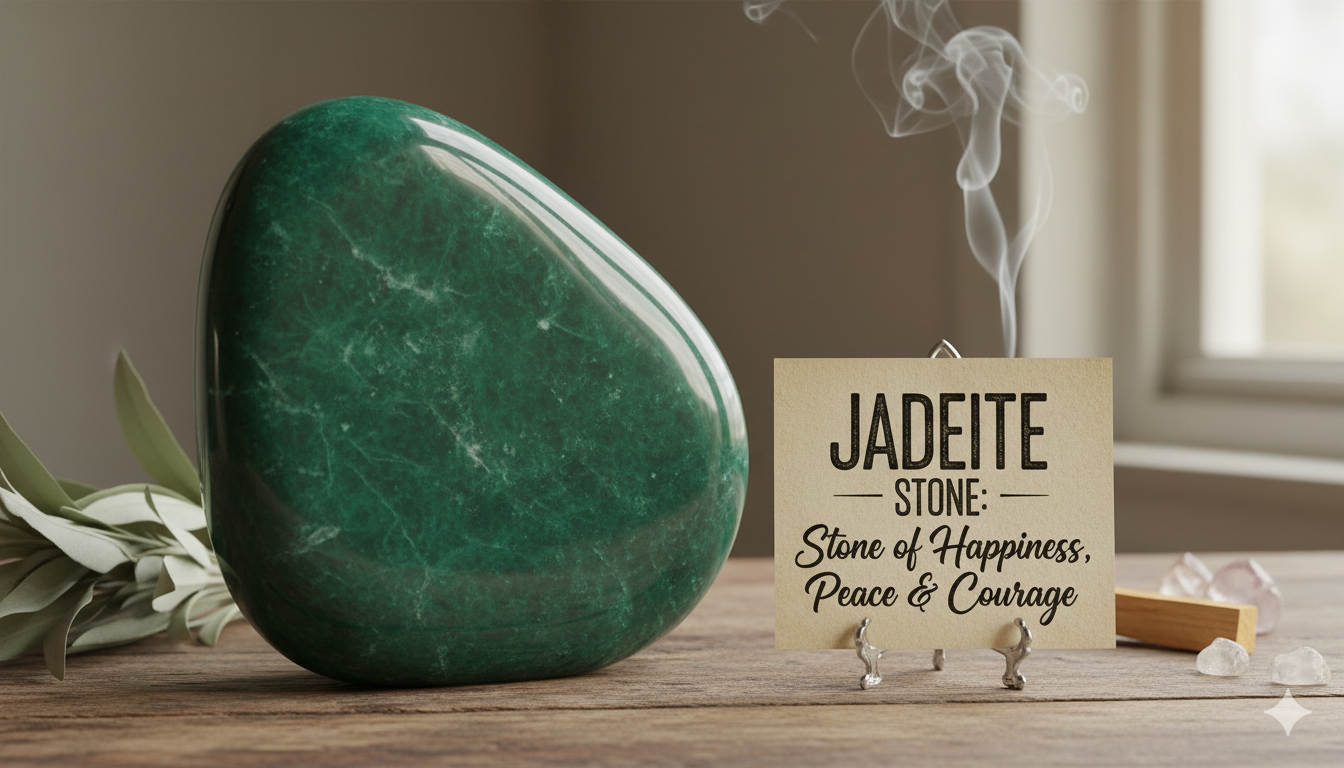
Jadeitový kameň: Stone of Happiness Peace & Courage
Jadeitový kameň (jadeite) sits at the intersection of geology, art history, and living tradition. It’s admired for its smooth feel, durability, and colors especially rich greens and it has been shaped into tools, ornaments, and sacred objects since prehistory.
At the same time, many modern wellness communities call jade “a stone of happiness, peace, and courage.” Those words are best understood as symbolic meanings built from older cultural ideas such as jade as virtue in China, a peace-making treasure in Māori culture (pounamu), and a life-associated sacred stone in Mesoamerica rather than as medically proven effects.
This research-based guide explains what jadeitový kameň is, why “jade” is actually more than one material, where jadeite forms, how different cultures used jade, what gemstone buyers should know about grading and treatments, and how you can use jadeite meaningfully (without overstating health claims).
What jadeitový kameň is in gemology and geology
In professional gemology, “jade” is a trade term, not a single mineral. The most reputable gem references describe jade as covering jadeite, nephrite, and in some cases closely related pyroxene aggregates such as omphacite.
Jadeite (jadeitový kameň) is a pyroxene mineral with an ideal chemical formula NaAlSi₂O₆, while nephrite is a rock composed mainly of tremolite–actinolite amphiboles (a different mineral family).
What makes jadeite special isn’t only hardness it’s also toughness. Jade objects don’t just resist scratching; they can resist breaking because jade forms as a densely interlocked aggregate (a tight “mosaic” of crystals). This is why even early Stone Age craftspeople could shape it into durable tools and ritual items that survived millennia.
Key physical properties commonly cited for jadeite include:
- Hardness: about 6.5–7 on the Mohs scale
- Density / specific gravity: around 3.3+ (jadeite is often heavier than many look-alikes)
- Refractive index: typically in the ~1.64–1.69 range for jadeite
Jadeite’s color range is broad—green is the most famous, but jadeite can also appear white, gray, black, brown, yellowish tones, and lavender. The Gemological Institute of America notes jadeite is semi-transparent to opaque and occurs in many shades, with color often unevenly distributed—something carvers intentionally use to create artistic effects.
Origins and historical foundations of jade across civilizations
A crucial historical detail: for much of world history, people didn’t clearly separate jadeite from nephrite. The two were formally distinguished by modern mineral analysis in the nineteenth century commonly credited to French mineralogist Alexis Damour in 1863 in many gem history references.
China’s long jade tradition
Jade has a uniquely long and continuous artistic tradition in China. Neolithic cultures there used jade heavily—so much so that the Metropolitan Museum of Art states jade use became one of the most lasting contributions of eastern China’s Neolithic cultures to later Chinese civilization.
Neolithic jade production required extraordinary patience: jade was too hard to cut like wood or soft stone, so craftspeople often relied on abrasion with sands and long polishing processes. Many excavated jades are found in burials arranged around elite bodies, indicating social and ritual importance beyond utility.
Importantly, major museum scholarship notes that ancient Chinese archaeological jades are overwhelmingly nephrite, not jadeite meaning the earliest Chinese “jade culture” was primarily nephrite-based, with jadeite arriving much later. The Smithsonian Institution (National Museum of Asian Art educational material) explicitly explains that jade refers to nephrite and jadeite, and that “true jades” found at ancient Chinese sites are nephrite.
Jadeite entered Chinese use at scale much later. Gemological research from GIA notes that the term “jade” had long applied to nephrite until jadeite was imported into China roughly 200–250 years ago, after which jadeite jewelry achieved record-setting prices while nephrite remained culturally central.
Mesoamerica’s jadeite tradition
In Mesoamerica, “jade” typically refers to jadeite specifically. The Met’s essay on jade in Mesoamerica describes how ancient peoples carved and revered jade, with the Maya often preferring bright green hues and the Aztec elite treating jade as among the most valued substances—reserved for gods and royalty on specific occasions.
A key geological and cultural point is sourcing: The Met’s collection notes that Mesoamerican jade comes from a restricted source area in the Motagua River Valley one reason jade became strongly associated with elite power and controlled access.
GIA’s research on Guatemala adds modern clarity to this picture: jadeite was identified in the Motagua River Valley area in the twentieth century, and work there expanded knowledge of jadeite deposits and commercial recovery.
Māori pounamu and the New Zealand context
Jade discussions often include New Zealand pounamu, but it’s important to be precise: pounamu is mainly nephrite, and authoritative sources emphasize there is no jadeite in New Zealand.
The Te Ara encyclopedia explains that pounamu is treasured and spiritually significant, used to denote status and authority, for adornment, and even for making peace values that connect strongly to the modern “peace and courage” storytelling around jade.
Cultural meanings behind happiness peace and courage
The “stone of happiness, peace, and courage” framing makes the most sense when you trace it to older symbolism especially in China, Māori culture, and Mesoamerica rather than treating it as a literal promise.
Virtue, moral character, and “courage” in Chinese thought
The GIA’s jade overview highlights cultural beliefs directly tied to ancient Chinese philosophy, noting that Confucius associated jade with virtue and described its brightness as representing heaven; it also notes the “bi” disk as a symbol of heaven.
The Royal Collection Trust adds further historical framing: it explains jade’s link to imperial courts and states that Confucius ascribed multiple virtues to jade, while also noting that jadeite was not used in China until the eighteenth and nineteenth centuries when imported from Myanmar.
This helps explain why “courage” appears in modern jade narratives: jade’s physical toughness became a metaphor for moral toughness standing firm under pressure an idea repeated across many historical interpretations of jade in Chinese culture.
Peace and protection in Māori pounamu tradition
Te Ara’s description that pounamu was used “for making peace” is not just poetic it reflects pounamu’s role as a culturally significant treasure used in relationship-building, gifting, and symbolic agreement.
Even though pounamu is nephrite (not jadeite), it influences global jade symbolism, because many English-language discussions treat jadeite and nephrite together as “jade.” In practical storytelling, pounamu’s peace-making role contributes heavily to the modern “peace stone” reputation.
Life, regeneration, and “happiness” meanings in Mesoamerica
Mesoamerican jade symbolism connects strongly to life, fertility, and renewal themes that easily translate into modern “happiness” language. A scholarly overview notes jade’s association with life, water, vegetation (especially maize shoots), and regeneration, plus widespread beliefs in healing powers in some cultures.
A highly cited academic study on Classic Maya religion also documents jade’s symbolic role related to maize, rulership, and the “vitalizing breath soul,” emphasizing that jadeite’s value was not merely decorative but deeply religious and ideological.
In short: modern wellness language (“happiness, peace, courage”) is a blend of older cultural themes virtue and moral resilience, peace-making social power, and life/regeneration symbolism repackaged into today’s self-care vocabulary.
Quality, authenticity, and common treatments in the modern jade market
Jadeite is one of the most treated and misrepresented gemstones on the global market, so deep research is incomplete without addressing enhancement and verification.
What makes jadeite valuable
GIA highlights that jade is valued for more than beauty: durability, rarity, and cultural heritage shape demand.
In jadeite, buyers typically evaluate:
- Color (fine vivid green can command extraordinary prices)
- Transparency and “texture” (the fineness of the aggregate)
- Evenness of color distribution, which can affect both beauty and carving design decisions
The ABC system and why it matters
A widely used classification system describes jadeite by the type of treatment applied. GIA’s own FAQ explains it clearly:
- “A jade” is natural jadeite (wax polishing may be acceptable)
- “B jade” is jadeite bleached with acid and then impregnated with polymer resin
- “C jade” is dyed material
This matters because B and C treatments can significantly change value, long-term stability, and how the stone ages.
What “B jade” actually is, scientifically
GIA’s peer-reviewed gemological research explains that “bleaching” is typically a two-step process: chemical removal of brown/gray components (often associated with iron staining in fractures), followed by polymer impregnation of the now more porous structure. It also notes that infrared spectroscopy is the only method that provided conclusive evidence of polymer impregnation in all tested cases in that study.
GIA also notes that acid bleaching is a common encounter in gemstone treatment discussions and that jadeite is among the commonly bleached gems.
Practical buying guidance that protects you
Because visual inspection can be unreliable, the safest approach is to buy jadeite with documentation from a respected laboratory and transparent disclosure of treatment. The LMHC information sheet emphasizes the complexity of jade because it’s an aggregate “rock” material that can include multiple pyroxenes, which is one reason advanced testing is often needed.
If your goal is a “high-integrity” jadeitový kameň piece, prioritize:
- laboratory identification and treatment disclosure (especially for significant purchases)
- sellers who clearly state whether the jadeite is treated, dyed, or resin-impregnated
Wellness claims mindful use and care for everyday wear
What research can and cannot claim
Jade has been tied to health ideas for centuries (even its Western name is linked to old beliefs about kidney or “loin” ailments), but modern evidence for gemstone “healing” is weak. Merriam-Webster explicitly connects the term’s history to Spanish beliefs that jade could cure kidney-related problems (the “loin stone” idea).
Modern health information sources caution that crystal healing is not strongly supported by scientific evidence. Healthline states that almost no scientific evidence supports crystals or energy healing in a medical sense, and it discusses placebo effects and suggestion as likely explanations for reported benefits.
Live Science similarly quotes psychologist Christopher French: there is no evidence crystal healing works beyond placebo, even if people subjectively feel better; it also warns not to replace medical care with crystal-based approaches for serious illness.
A responsible, research-aligned framing is: jadeite may support wellness as a meaningful symbol, ritual object, or mindfulness anchor, not as a proven medical treatment.
How people use jadeite for “happiness peace courage” in daily life
If you want to use jadeitový kameň in a grounded, psychologically realistic way, think of it like a tangible reminder:
- “Peace”: wear it during stressful days as a cue to slow breathing and return attention to the present moment (a “ritual trigger”).
- “Courage”: treat it like a personal symbol of resilience—an object that represents “tough under pressure,” echoing the classic jade virtues.
- “Happiness”: connect it to gratitude or celebration rituals (anniversaries, gifts, family milestones), consistent with jade’s long role in adornment, ritual objects, and meaningful gifting.
Care and cleaning
Jadeite is durable, but it still deserves care especially if you want the polish to stay bright and avoid damage to settings or surface wax coatings. Because treatments exist (waxing, polymers, dyes), gentle cleaning is best unless you are certain of the stone’s condition. GIA’s treatment discussions and the prevalence of polymer-impregnated “B jade” support a conservative approach: avoid harsh chemicals and extreme heat exposure that could affect polymers or dyes.
A safe, widely recommended approach for jade jewelry is mild soap, lukewarm water, and a soft cloth, followed by drying—especially for pieces you wear daily.
Responsible sourcing and modern ethical concerns
A complete understanding of jadeitový kameň must include where top jadeite often comes from today and what that can mean ethically.
Gemological research from GIA states that while jadeite deposits exist in multiple places (including Guatemala, Japan, Russia, and California), Myanmar remains the primary source of top-grade jadeite, particularly associated with the Hpakan region.
However, modern investigative and human rights reporting documents serious issues in Myanmar’s jade sector. Global Witness reports that Kachin State hosts some of the richest jade mines in the world and links the industry to longstanding patterns of exploitation, conflict financing, corruption, and dangerous illegal mining.
Major journalism outlets such as Reuters have reported repeated fatal landslides and accidents in the jade-mining hub of Hpakant, describing the region as the center of a secretive jade industry that draws impoverished workers and experiences recurring deadly disasters.
For buyers who care about the ethics behind their stone, practical steps include:
- asking for transparent supply chain information where possible
- preferring sellers who support independent lab verification and clear disclosure (treatment + origin claims)
- considering antique or recycled jade jewelry as a harm-reduction choice (when authenticity is verified)
Jadeitový kameň can symbolize peace and courage yet the modern jade trade reminds us that the symbolism feels most honest when paired with responsibility and transparency.
You may also read: What is Sodziu? Exploring Village Life Culture Wellness & Mindfulness
Leet Coffee: Premium Coffee for Gamers & Digital Creators
For More Information, visit imagefaps