Nahttypen Guide 2026: Master Every Seam Type in Professional Sewing
In the world of fashion design and garment construction in 2026, Nahttypen or seam types are far more than just points where two pieces of fabric meet. They are the skeletal framework of every wearable item, from high-fashion couture to rugged outdoor gear. A seam is a functional bond that must balance three critical factors: tensile strength, elasticity, and aesthetic finish. Choosing the wrong seam type can lead to “seam pucker,” structural failure, or an amateurish appearance that ruins the value of the garment.
As we move further into an era of sustainable fashion and high-performance textiles, understanding the engineering behind different Nahttypen has become a prerequisite for success. This guide will navigate you through the traditional techniques and the futuristic innovations defining sewing today, ensuring your projects are built to last a lifetime.
The Plain Seam (Einfache Steppnaht): The Foundation of Sewing
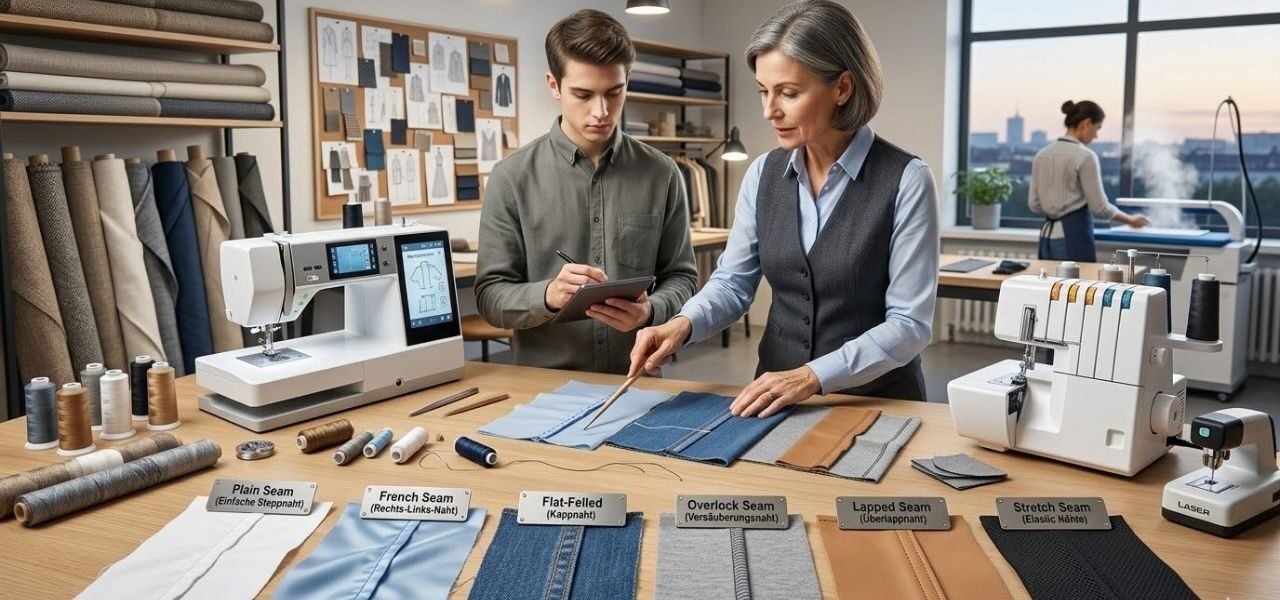
The plain seam, often referred to in German as the Einfache Steppnaht, is the DNA of all garment assembly. It is the most common of all Nahttypen because of its simplicity and versatility. By placing two fabric pieces “right sides together” and stitching a set distance from the edge, you create a hidden bond that allows the fabric to drape naturally.
In 2026, even with the rise of automated sewing, the plain seam remains the benchmark for testing thread tension and stitch compatibility. However, its simplicity is deceptive; a professional plain seam requires precise “seam allowance” management and perfect pressing. Whether you are working with lightweight cotton or heavy canvas, the plain seam serves as the starting point from which all other complex seam structures are derived. It is the silent workhorse of the sewing world, providing the clean lines we expect in modern minimalist fashion.
French Seams (Rechts-Links-Naht): The Luxury Standard
When it comes to high-end finishes and delicate fabrics like silk, chiffon, or organza, the French seam (Rechts-Links-Naht) is the undisputed queen of Nahttypen. This “seam within a seam” completely encases the raw edges of the fabric, leaving a polished, professional look on both the inside and outside of the garment.
In 2026, as the “Slow Fashion” movement gains even more momentum, the French seam is highly valued for its ability to prevent fraying without the need for bulky overlocking. It adds a level of structural integrity to thin fabrics that would otherwise pull apart under stress. While it requires twice the effort stitching first with wrong sides together, trimming, and then stitching with right sides together the result is a couture-level finish that significantly increases the retail value of a garment. It is the hallmark of a tailor who prioritizes internal beauty as much as external style.
Flat-Felled Seams (Kappnaht): Built for Durability
If the French seam is for luxury, the Flat-Felled seam (Kappnaht) is for power and durability. This is the seam type you see on the side of your favorite pair of denim jeans or heavy-duty workwear. The flat-felled seam is unique among Nahttypen because it is reversible and extremely strong; the fabric edges are interlocked and double-stitched, laying completely flat against the garment.
This prevents any chafing against the skin, making it a favorite for sportswear and children’s clothing in 2026. Because it involves four layers of fabric, it requires a heavy-duty needle and precise topstitching. This seam is designed to survive hundreds of wash cycles and extreme physical stress. In the context of 2026’s focus on “Longevity Engineering,” the flat-felled seam is often the first choice for brands that offer lifetime warranties on their apparel, symbolizing a commitment to rugged, indestructible construction.
Comparison of Primary Nahttypen
| Seam Type | German Term | Strength | Best For |
| Plain Seam | Einfache Steppnaht | Medium | General Construction |
| French Seam | Rechts-Links-Naht | High (Sheers) | Silk, Chiffon, Luxury |
| Flat-Felled | Kappnaht | Extra High | Denim, Workwear, Tents |
| Lapped Seam | Überlappnaht | High | Leather, Suede, Felt |
Overlock and Serged Seams (Versäuberungsnähte)
In the high-speed world of ready-to-wear fashion, Versäuberungsnähte or overlock seams are the standard for finishing raw edges. An overlocker (serger) trims the fabric and encases the edge with three to five threads simultaneously. In 2026, the technology behind overlocking has evolved to include “smart-tension” sensors that adjust for fabric thickness in real-time. This seam type is essential for knit fabrics and jersey, as the looped nature of the stitches allows the seam to stretch without breaking.
While some purists argue that overlocking is “fast fashion,” it remains one of the most functional Nahttypen for preventing fraying on woven fabrics. A well-executed overlock seam should feel soft against the skin and look uniform. For modern tailors, mastering the overlock is about efficiency and ensuring that the internal components of a garment can withstand the friction of daily movement and repeated laundering.
Lapped Seams (Überlappnaht): Precision for Heavy Materials
The Lapped Seam (Überlappnaht) is a specialized entry in the catalog of Nahttypen, primarily used for materials that do not fray, such as leather, suede, felt, or high-tech bonded fabrics. Instead of putting right sides together, one piece of fabric is “lapped” over the other and topstitched. This reduces bulk significantly, which is crucial when working with thick skins or 2026’s new synthetic “bi-leathers.”
The lapped seam is also used in the construction of rainwear and sails, where a flat profile is necessary to prevent water from pooling or wind from catching. Because the edge is visible, the cutting must be surgically precise. In contemporary fashion, the lapped seam is often used as a decorative element, using contrasting thread colors to highlight the geometric lines of a jacket or handbag. It is a seam that demands confidence, as there is no hidden margin to hide mistakes.
Bound Seams (Eingefasste Nähte): The Ultimate Edge Detail
Bound seams, or Eingefasste Nähte, involve wrapping the raw edge of a seam with a separate strip of fabric, usually bias tape. This is one of the most sophisticated Nahttypen, frequently used in unlined jackets and coats where the interior of the garment is visible. In 2026, “Hong Kong Finishes” a type of bound seam have seen a resurgence in bespoke tailoring.
By using a contrasting silk or satin binding, a tailor can turn a functional necessity into a stunning design feature. Bound seams provide a smooth, rounded edge that is incredibly comfortable and prevents any irritation from coarse fabrics like wool. While it is time-consuming and requires a high level of dexterity to ensure the binding is even on both sides, it is a definitive sign of quality. It tells the customer that no shortcuts were taken, and every inch of the garment has been curated for comfort and style.
Decorative Seams (Ziernähte): Aesthetics and Structure
While many Nahttypen are purely functional, Ziernähte (Decorative Seams) bridge the gap between engineering and art. These include topstitching, pintucks, and pick-stitching. In 2026, decorative seaming has been revolutionized by computerized sewing machines that can execute complex embroidery-like patterns along a seam line. However, the most classic decorative seam is still the simple topstitch, often seen on coat collars and pockets.
Beyond looking good, decorative seams often serve to reinforce a structural seam underneath or to hold a facing in place. A perfectly straight Ziernaht is the signature of an expert; it requires a steady hand and a deep understanding of thread weight and needle size. In the luxury automotive and luggage industries, these seams are often stitched with thicker, high-sheen threads to convey a sense of opulence and meticulous hand-craftsmanship that machines find difficult to replicate perfectly.
Stretch Seams (Elastic Nähte): Handling the Modern Wardrobe
With the 2026 obsession with “Athleisure” and “Activewear,” the importance of Elastic Nähte (Stretch Seams) cannot be overstated. Standard straight stitches will snap the moment a stretch fabric is pulled. Therefore, specialized Nahttypen like the zigzag stitch, the triple-stretch stitch, and the flatlock have become essential.
The flatlock seam is particularly important in 2026; it is a seam that joins two pieces of fabric edge-to-edge without any overlap, creating a perfectly flat, friction-free join that is ideal for leggings and compression gear. These seams must be able to expand and contract thousands of times without losing their shape. Achieving the correct “Stretch Ratio” requires specific polyester or nylon threads that possess high elasticity. For a garment to rank as “professional grade” in the fitness industry, its stretch seams must be flawless, durable, and capable of moving with the human body in its most extreme ranges of motion.
Industrial Seam Standards and ISO Classifications 2026
For those moving from hobbyist to professional production, understanding the international standards for Nahttypen is vital. In 2026, the ISO 4916 standard classifies seams into eight distinct categories based on their construction. This universal language allows designers in Berlin to communicate perfectly with manufacturers in Vietnam or Turkey.
- Class 1 (Lapped): Overlapping layers.
- Class 2 (Bound): Edges wrapped in tape.
- Class 3 (Flat): Edge-to-edge joins.
- Class 4 (Ornamental): Decorative lines.
These classifications ensure that every “stitch per inch” (SPI) and “thread tension” setting is consistent across global supply chains. By adhering to these industrial standards, a brand ensures that its products meet the “Tear Strength” and “Seam Slippage” requirements necessary for international safety and quality certifications. For anyone looking to dominate the 2026 fashion market, the ISO Nahttypen chart is an essential piece of technical documentation.
Choosing the Right Needle and Thread for Your Seam
The success of any of the Nahttypen mentioned in this guide depends entirely on the “Holy Trinity” of sewing: the Needle, the Thread, and the Fabric. In 2026, we have seen the introduction of “Titanium-Coated” needles that stay sharp longer and reduce friction heat, which is essential for sewing dense synthetic fibers. If you use a heavy needle on a French seam, you will leave permanent holes; if you use a fine thread on a Flat-Felled denim seam, it will snap instantly.
- Woven Fabrics: Require “Sharp” or “Microtex” needles.
- Knit Fabrics: Require “Ballpoint” or “Stretch” needles.
- Thread Choice: 2026 favors recycled polyester threads for strength and mercerized cotton for high-end tailoring.
Matching your tools to your chosen Nahttypen is the difference between a project that looks “homemade” and one that looks “store-bought.” Always test your combination on a scrap piece of the same fabric before starting your final garment.
Seam Finishes: Handling the Raw Edges
A seam isn’t truly finished until the raw edges are handled. Beyond the primary Nahttypen, “Seam Finishes” determine the life expectancy of the garment. In 2026, there is a major trend toward “Clean Finishing,” where edges are turned under and stitched (hemmed) or pinked with zig-zag shears for a vintage aesthetic. Pinking is a fast and low-bulk way to prevent fraying on stable wovens, while “Zigzag finishing” is the home-sewer’s version of an overlock.
For unlined luxury garments, “Self-Finishing” seams like the French or Flat-Felled are preferred. The choice of finish affects how the seam “presses.” A professional tailor spends as much time at the ironing board as they do at the sewing machine. Proper pressing using steam and a tailor’s clapper sets the stitches into the fabric, turning a bumpy, puckered line into a crisp, professional seam that defines the garment’s silhouette.
High-Tech Seaming: Laser and Ultrasonic Welding
Welcome to the frontier of 2026 Nahttypen: Threadless Seams. In high-performance outdoor gear and “Techwear,” traditional needles and threads are being replaced by Ultrasonic Welding and Laser Bonding. These methods use high-frequency vibrations or heat to melt the fibers of synthetic fabrics together, creating a waterproof, airtight bond that is stronger than the fabric itself. These “Welded Seams” are entirely flat, eliminating the weight of thread and the possibility of “needle holes” that could leak water.
While currently dominated by industrial manufacturers, we are seeing the first “Home Ultrasonic Tools” enter the market in 2026 for hobbyists working with specialized waterproof-breathable fabrics. This technology represents the ultimate evolution of the seam, where the join becomes a continuous part of the material. For athletes and explorers, these high-tech Nahttypen are a game-changer, providing protection and performance that traditional sewing simply cannot match.
Troubleshooting Common Seam Issues
Even the most experienced sewers encounter problems when experimenting with different Nahttypen. The most common issue in 2026 is “Seam Pucker,” often caused by high-tenacity polyester threads pulling on modern lightweight fabrics. To fix this, one must adjust the “Differential Feed” on the sewing machine or lower the thread tension. Another common problem is “Skipped Stitches,” which usually indicates a dull needle or an incorrect needle type for the fabric density.
If your seams are “Wavy” (common in knits), it means the fabric was stretched while sewing; using “Wash-away Stabilizer” or a “Walking Foot” can solve this instantly. Understanding the “Why” behind a failed seam is how you grow as a maker. By systematically checking your needle, thread, tension, and feed dog settings, you can overcome any obstacle and ensure that your Nahttypen remain consistent from the first stitch to the last.
Sustainable Sewing: Seams for Longevity and Repair
In 2026, sustainability is no longer an option; it is a requirement. The choice of Nahttypen plays a huge role in the “Circular Economy.” High-quality seams like the Flat-Felled or French seam ensure that a garment lasts for decades, reducing the need for fast-fashion replacements. Furthermore, choosing seams that are “Repair-Friendly” is a growing trend.
For example, leaving a slightly larger seam allowance allows for future alterations if the wearer’s size changes. “Reinforcement Stitching” (like bar-tacks) at stress points like pockets and flys prevents the most common types of garment failure. By viewing sewing as an act of “Garment Engineering,” we can create clothes that aren’t just fashionable today, but become the vintage treasures of tomorrow. Sustainable Nahttypen are about respect for the fabric, respect for the time it takes to sew, and respect for the planet by creating something that doesn’t end up in a landfill.
Conclusion
Mastering the various Nahttypen is the journey from being someone who “knows how to use a sewing machine” to becoming a true “Garment Architect.” Whether you are using the humble plain seam for a summer dress, the rugged flat-felled seam for a pair of jeans, or experimenting with 2026’s ultrasonic welding, your choice of seam defines the quality of your work. Every stitch is a decision, and every seam is a signature.
As technology continues to evolve, the fundamentals of structural integrity, tension, and finishing remain the same. We hope this powerful guide has provided you with the technical insight and inspiration needed to elevate your sewing projects to a professional level. Remember, the beauty of a garment is only as strong as the seams that hold it together. Keep practicing, keep experimenting, and let your Nahttypen be the foundation of your creative legacy in the fashion world.
FAQs
In 2026, the Flat-Felled Seam (Kappnaht) remains the strongest traditional seam for heavy fabrics like denim, canvas, and workwear. Its interlocked structure and double-topstitching provide maximum resistance to tearing and seam slippage. For synthetic heavy-duty materials, Ultrasonic Welding is the strongest modern alternative.
Choose a French Seam for luxury, sheer, or lightweight woven fabrics where you want a clean, hidden finish and don’t want to use a serger. Choose an Overlock Seam for knit fabrics (jersey, spandex) or when speed and mass-production efficiency are the priority. French seams add value and “luxury feel,” while overlock seams offer “functional stretch.”
For stretch fabrics in 2026, the most effective Nahttypen are the Flatlock Seam, Triple-Stretch Stitch, and Narrow Zigzag. These allow the thread to move with the fabric’s fibers. A standard straight stitch should never be used on high-stretch materials, as it will snap immediately under tension.
Seam pucker is usually caused by incorrect thread tension, a dull needle, or the “pull” of high-tenacity thread on lightweight fabric. In 2026, the best fix is to use a Microtex needle, reduce your machine’s top tension, and ensure you are using a thread with a similar “give” to your fabric. Using a “Walking Foot” also helps feed the fabric layers evenly.
While Laser and Ultrasonic Welded Seams are the future for high-performance activewear and waterproof gear, traditional Nahttypen (sewn with needle and thread) will always be the standard for natural fibers like cotton, wool, and silk. In 2026, we see a hybrid industry where both methods are used depending on the material’s properties.
You may also read: Mint Mobile Review 2026: Is the $15 King Still Worth It Post-Acquisition?
Delta Flight DL153 Diversion: Causes Passenger Updates & Rights
For More Information, visit imagefaps